
Building Consent for Renovations: Which Auckland Projects Need One in 2026
Quick answer: You need a building consent for renovations that change structure, plumbing, drainage or waterproofing — and usually don’t for like-for-like replacement in the same position. This guide shows you exactly where that line falls for kitchens, bathrooms, walls, extensions and recladding in Auckland.
Here’s the question we get asked more than any other at Sonder Architecture: “Do I actually need a building consent for this, or can I just get a builder in?”
Fair question. The answer depends entirely on what “this” is. Swap your kitchen cabinetry and benchtop? No consent. Move the sink two metres to a new island? Consent. Same room, similar budget, completely different rules.
The frustrating part for homeowners is that the rules aren’t written room by room. They’re written around building systems — structure, weathertightness, plumbing, drainage, fire safety — which means a “small” bathroom job can need a consent while a much bigger cosmetic makeover doesn’t. A building consent, if you’ve never dealt with one, is Auckland Council’s formal approval confirming your construction work will meet the New Zealand Building Code (the national performance standards every build has to meet). It’s about how you build. It’s separate from a resource consent, which is about what you’re allowed to do with your land — more on that distinction shortly.
We’re an Auckland architectural studio whose design team includes a Licensed Building Practitioner in the Design Class — an LBP is a building professional certified by the Government to carry out or supervise certain regulated work, and the Design Class licence is what lets us produce consent-ready drawings for the structural and weathertightness work the law restricts. Sorting out which renovations need consent is the first thing we do on nearly every project that comes through our studio at 16 Link Drive, Wairau Valley. This guide walks through the consent triggers renovation by renovation, so you know where your project stands before you spend a dollar.
One thing before we start. If you’ve heard about the new granny flat consent exemption and you’re hoping it covers your renovation — it doesn’t. That exemption is for new standalone dwellings only. We’ll explain why below, because it’s catching a lot of Auckland homeowners out this year.
Where the Consent Line Actually Sits for Renovations
Start with the legal default, because it surprises people. Under the Building Act 2004, all building work needs a building consent — unless it’s specifically exempted. The exemptions live in Schedule 1 of the Act (the schedule that lists low-risk work you can do without a consent, within set limits). So the real question isn’t “does my renovation need consent?” It’s “does my renovation fit inside a Schedule 1 exemption?”
That reframing matters. It puts the burden of proof where the law puts it — on the work being exempt, not on the council proving it isn’t.
The Like-for-Like Principle
Most renovation exemptions follow one logic: replacing a component with a comparable one, in the same position, doing the same job, is usually exempt. Changing what the component does, where it sits, or what it connects to usually triggers a consent.
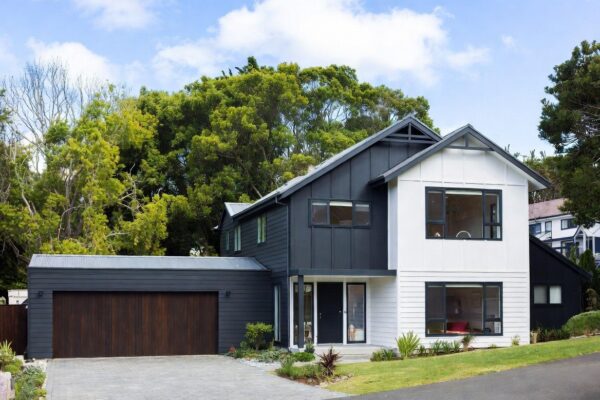
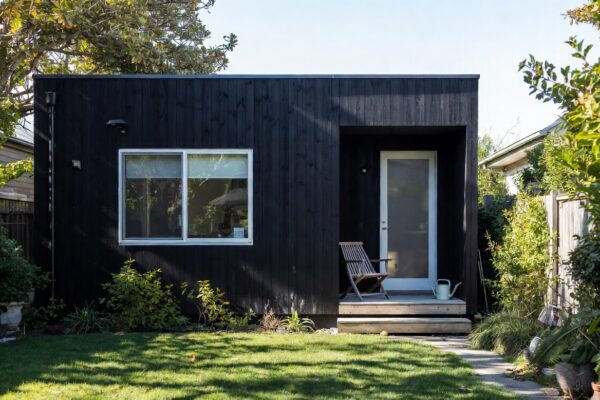
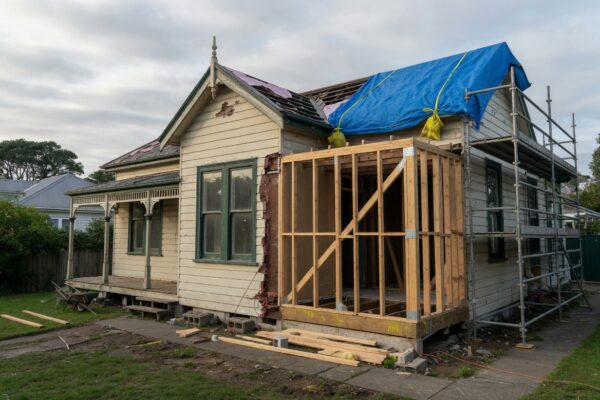
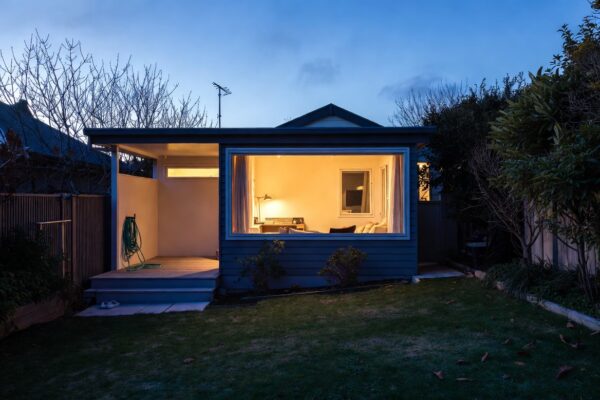
A renovation that went through consent: Milford Unit Renovation on the North Shore.
That’s why you can replace a toilet, vanity or sink in the same spot without consent, but adding a second toilet — anywhere — needs one. It’s why repainting, new flooring, new cabinetry and wallpaper never need consent, but cutting a new window opening into an external wall does. The exempt work isn’t changing how the building performs. The consented work is.
According to MBIE’s Schedule 1 guidance, even exempt work must still comply with the Building Code. No consent doesn’t mean no rules. It means the council isn’t checking — you’re carrying the compliance risk yourself.
We keep a running plain-English breakdown of every exemption category in our guide to what you can build without a building consent in NZ, so we won’t repeat the full list here. This article is about the renovations that sit near the line.
Restricted Building Work — the Second Layer
Some consented renovation work goes a step further. Restricted Building Work (RBW) is work on a home’s structure or weathertightness that, by law, must be designed and carried out — or supervised — by a Licensed Building Practitioner. Removing a load-bearing wall, recladding, building an extension: all RBW. Your designer signs a Certificate of Design Work, your builder provides a Record of Work, and both end up on the council file as proof the regulated work was done by licensed hands.
This is the part of the system Sonder sits inside every day. It’s also a quick credibility check when you’re comparing designers: anyone producing consent drawings for RBW should hold a Design Class licence you can verify on the public LBP register.

Building Consent vs Resource Consent — Two Different Permissions
Quick but important distinction. A building consent checks your construction against the Building Code. A resource consent is Auckland Council’s permission to use your land in a particular way under the Auckland Unitary Plan (the single planning rulebook covering all of Auckland — zoning, height limits, site coverage, character protections). A renovation can need one, both, or neither. An internal bathroom shuffle might need only a building consent. A second-storey addition on a Grey Lynn villa inside a Special Character Area might need both. Our full guide to building consents in NZ covers the process end to end; this article stays focused on which renovations trigger it.
Important: The granny flat exemption that took effect on 15 January 2026 applies only to new standalone dwellings up to 70m² with a simple design, built or supervised by licensed professionals, with the council notified before and after the build. It does not exempt renovations, alterations or conversions of your existing home — Auckland Council’s exemption page sets out the conditions.
💡 Homeowner tip: Before assuming anything, run your project through Auckland Council’s free “Can I build it?” online tool. It takes ten minutes and gives you a written starting position you can sanity-check with a designer.
So that’s the framework. Now let’s apply it to the rooms where Auckland renovation budgets actually go.
Building Consent for Kitchen, Bathroom and Laundry Renovations
Wet areas are where the like-for-like principle earns its keep — and where most consent confusion lives. The trigger in these rooms is almost never the joinery or the tiles. It’s the plumbing, the drainage, and the waterproofing.
Kitchens: the Island Bench Question
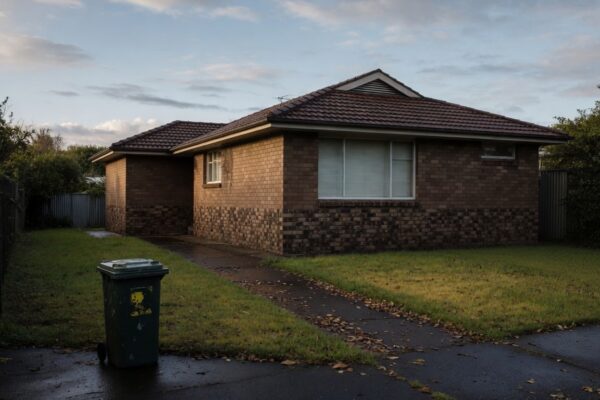
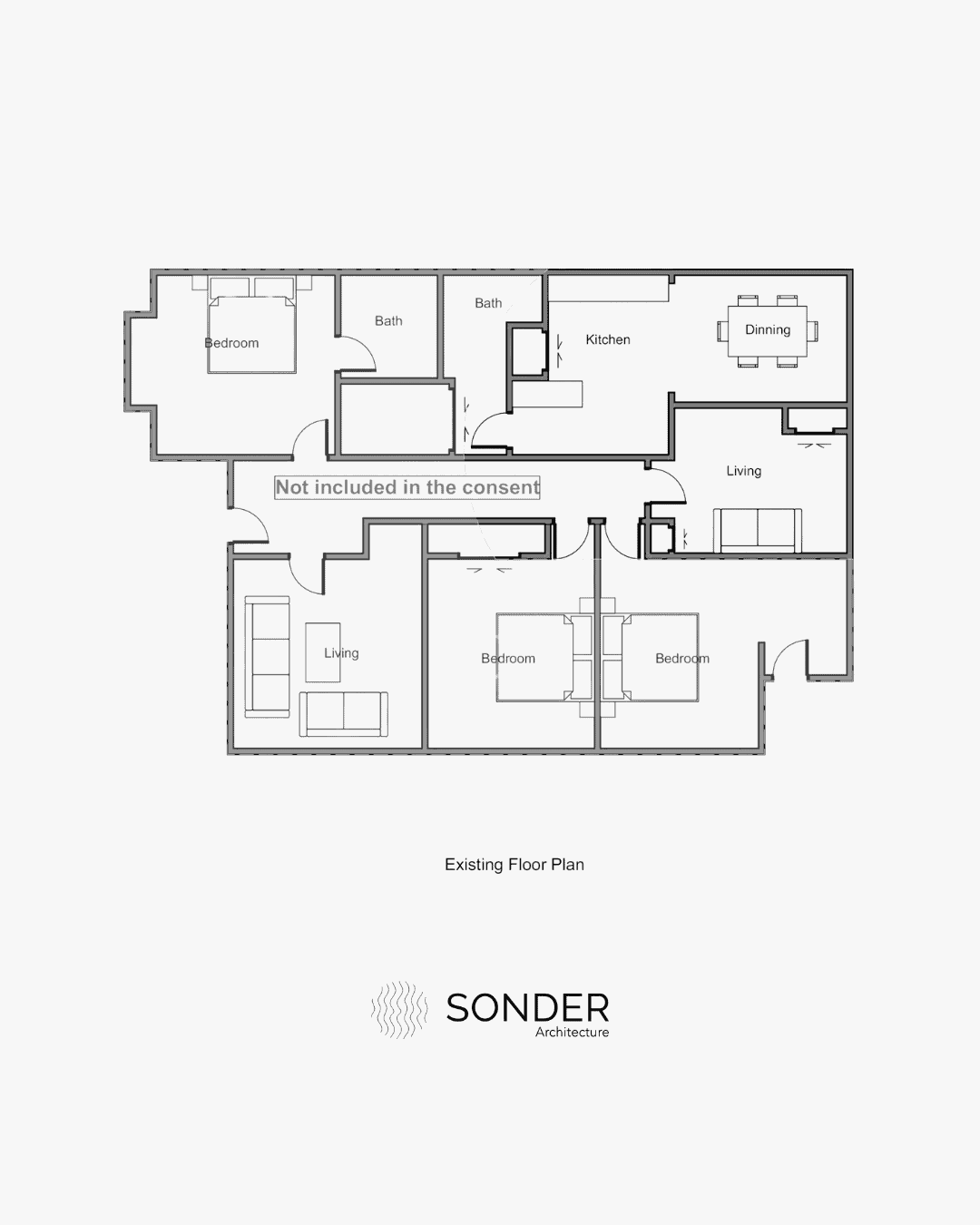
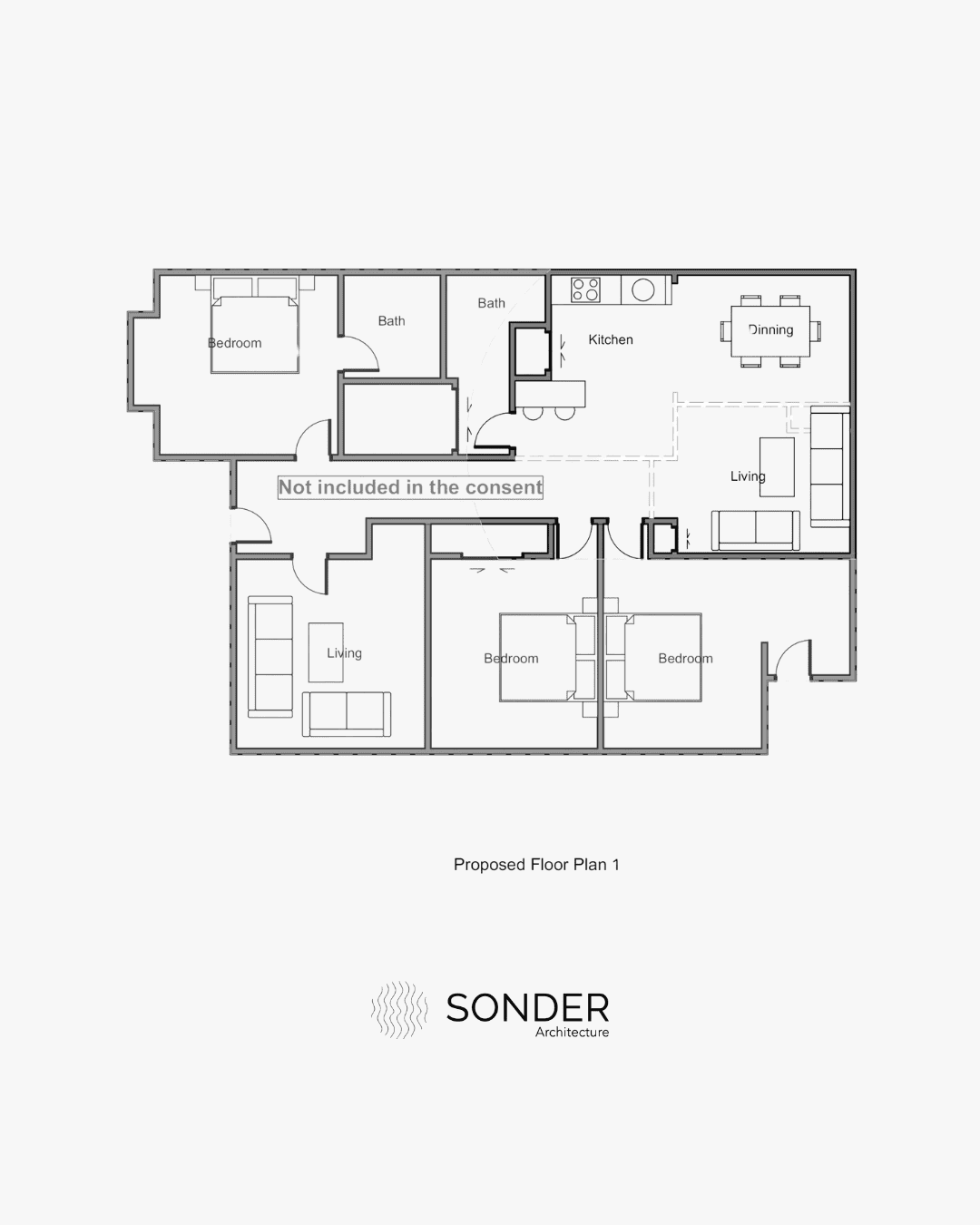
Imagine you’ve bought a 1960s brick-and-tile in Remuera and the kitchen is original — separate scullery wall, sink under the window, the lot. You want new cabinetry, stone benchtops, a tiled splashback and better lighting. None of that needs a building consent. It’s cosmetic and joinery work, fully exempt.
 Existing
 Proposed
Now add the thing everyone wants: an island bench with the sink in it. The moment that sink moves, you’re running new water supply and new drainage to a new position. New sanitary plumbing in a new location needs a building consent, because the council has to confirm the water supply and foul water drainage (the pipework carrying waste water away) will meet the Building Code. The work itself must be done by a registered plumber and drainlayer regardless.
Same logic in reverse: a registered plumber swapping your existing sink or taps in the same position is exempt work. The position is the pivot point, not the fixture.
Bathrooms: Where the Membrane Changes Everything
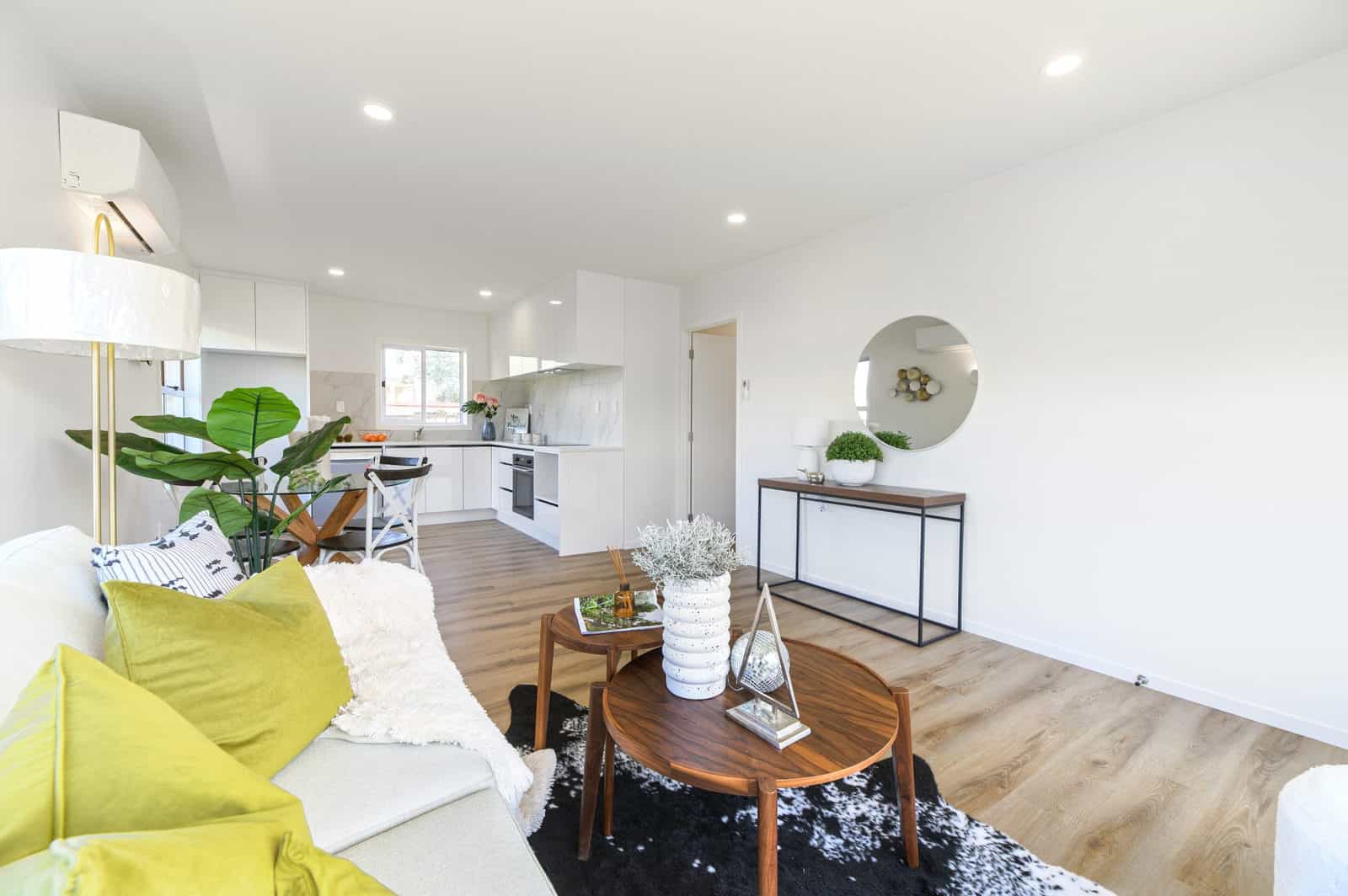
Bathrooms carry one extra trigger that kitchens don’t — waterproofing. A fully tiled wet-area shower needs a waterproof membrane, and installing or replacing that membrane is consented work, because internal moisture failures are exactly the kind of slow, expensive damage the Building Code exists to prevent. Anyone who’s dealt with a leak under a tiled shower in a Ponsonby villa knows why the council cares: by the time you can see the problem, the framing underneath has been wet for months.
The practical split for a typical Auckland bathroom renovation looks like this:
| Bathroom / Kitchen Work | Consent Needed? | Why |
|---|---|---|
| New vanity, toilet or sink in the same position | No | Like-for-like replacement, exempt under Schedule 1 |
| New cabinetry, benchtops, splashback, flooring, paint | No | Cosmetic work — doesn’t change building performance |
| Moving a sink, toilet or shower to a new position | Yes | New plumbing and drainage must be checked against the Building Code |
| Adding a new bathroom, toilet or ensuite | Yes | New sanitary fixtures and drainage, always consented |
| Tiled wet-area shower with waterproof membrane | Yes | Internal moisture protection is consented work |
| Acrylic shower unit replacing an old one, same spot | No | Like-for-like fixture replacement |
One pattern worth noticing in that table: the consent triggers cluster around anything new — new position, new fixture, new membrane. Keep everything where it is and a surprisingly deep renovation stays exempt.

Laundries and Second Kitchens
Laundries follow the same plumbing logic — relocate the tub or add one where there wasn’t plumbing before, and you’re in consent territory. Second kitchens deserve a separate warning. Adding a kitchenette to create a self-contained space — say, for a teenager or a flatmate — can shift your project from a building consent question to a planning question, because the Unitary Plan treats a self-contained unit differently from a bedroom with a sink. If that’s the direction you’re heading, look at our guide to granny flat design in NZ before you commit to a layout — the rules for a proper minor dwelling changed substantially this year and there may be a smarter path than squeezing a kitchenette into the existing footprint.
Important: Even exempt plumbing work must be carried out by a registered plumber or drainlayer and still has to comply with the Building Code — MBIE’s Schedule 1 guidance is explicit on this. Exempt means unchecked, not unregulated.
💡 Homeowner tip: Designing your new kitchen or bathroom around the existing plumbing positions can keep a renovation consent-free and save weeks. Decide whether the island bench is worth a consent before you fall in love with the layout — not after.
Wet rooms are the high-frequency cases. The bigger-ticket triggers — walls, extensions, cladding — are where the stakes go up.
Walls, Extensions and Recladding: Renovations That Always Need Consent
If wet areas are about plumbing, everything in this section is about two things the Building Act guards most closely: structure and weathertightness. Touch either and the consent question stops being a question.
Removing or Altering Walls
The open-plan conversion is Auckland’s favourite renovation, and it’s consented work whenever the wall is load-bearing — carrying roof, floor or bracing loads. A new beam has to be engineered, sized and inspected, because everything above it depends on the result. Removing a load-bearing wall is also Restricted Building Work, so an LBP must design and carry out or supervise it.
“Homeowners often assume a wall is non-structural because it’s ‘just a hallway wall.’ In a pre-1940s villa, that hallway wall is frequently doing bracing work the house can’t lose. We check the load path before anyone picks up a saw — it’s a one-hour exercise that prevents a five-figure mistake.”
— Sonder Architecture Team
The full picture — what an LBP actually checks, what it costs, and the genuinely non-structural cases that stay exempt — is in our dedicated guide to consent to remove an internal wall in NZ.
Extensions and Additions
No grey area here. Any extension — single-storey, second-storey, even a modest bump-out for a bigger dining space — needs a building consent. You’re creating new foundations, new structure and new external envelope, all of which the council must check against the current Building Code. And “current” matters in 2026: new building envelope has to meet today’s insulation and external moisture requirements, not the standards your house was built to. That’s not a burden, it’s the upside — the new part of your home performs to modern standards.
Extensions are also where the resource consent layer most often appears. Height in relation to boundary (the rule controlling how close and how tall you can build near a neighbour’s boundary), site coverage limits, and character protections can all apply depending on your zone. A rear extension in Flat Bush is usually a straightforward building consent. The same extension on a villa in a Ponsonby Special Character Area (a designated zone where extra design rules protect the streetscape) is a different conversation entirely.
Important: If your home sits under a heritage overlay (a planning rule protecting historic buildings and character streets) or in a Special Character Area — common across Ponsonby, Grey Lynn, Mt Eden and parts of the North Shore — external changes can need resource consent even when the building work itself is minor. Check your property’s overlays on Auckland Council’s Unitary Plan viewer, and see our guide to the heritage overlay in Auckland for what you can and can’t change.
Recladding and the External Envelope
Recladding is consented work, full stop — and it’s Restricted Building Work too, because cladding is the weathertightness system. For Auckland homes built between the mid-1990s and mid-2000s with monolithic plaster cladding, recladding is often less a style choice than a remediation project, and the consent process is what turns a stigmatised house back into a bankable one. The consent file and Code Compliance Certificate at the end are precisely what future buyers, valuers and insurers will ask for.
Window and door replacement follows the same logic in miniature: like-for-like replacement in the same opening can be exempt, but enlarging an opening or cutting a new one penetrates structure and weathertightness — consent.
Garage Conversions, Decks and the Outdoor List
Converting a garage into a habitable room usually needs consent because you’re changing how the space is used — it now has to meet Building Code requirements for insulation, ventilation, moisture and natural light that a garage never did. One of our clients in Titirangi assumed lining and carpeting their double garage was cosmetic; the moment it became a sleepout-style bedroom, it wasn’t. We’ve broken down the numbers and the consent path in our garage conversion costs guide for Auckland.
Decks, fences, sheds and pergolas have their own Schedule 1 thresholds — a deck is generally exempt below 1.5 metres of potential fall height, for instance — and the full outdoor list lives in our guide to consent-free building work rather than here.
💡 Homeowner tip: Order your property file from Auckland Council before planning structural work on an older home. It shows what’s already consented — and surfaces any unconsented surprises a previous owner left behind, while you can still plan around them.
Which raises the obvious question: what actually happens if the work goes ahead without the consent it needed?
Renovating Without Consent: What It Costs Later — and How to Get Certainty First
We’ll be straight with you: plenty of unconsented renovation work exists in Auckland, and most of it was done by people who genuinely thought it was fine. The problem is that unconsented work doesn’t surface when you do it. It surfaces when you sell, refinance or claim insurance — the three moments you can least afford it.
The LIM Report Moment
When you sell, buyers and their lawyers order a LIM — a Land Information Memorandum, the council’s detailed report on your property covering zoning, consent history and known issues. Work that should have been consented and wasn’t shows up as a gap between what the council has on file and what’s physically there. A 1980s brick-and-tile in Takapuna listed with “third bedroom and second bathroom” that the property file says is a two-bed, one-bath? Every buyer’s lawyer will flag it. Banks can decline lending against it. Insurers can decline claims that trace back to it.
The downstream version of this problem — finished consented work that never got its final sign-off — is its own trap. The Code Compliance Certificate, or CCC, is the document the council issues confirming the completed work matches the consent and meets the Building Code. We’ve covered what happens when it’s missing in can you sell a house without a CCC — short version: you can, but you’ll pay for it in price, buyer pool and lawyer hours.
Retrofitting legality is possible through a Certificate of Acceptance (a council certificate for work done without consent that can be shown to comply), but it’s slower, costs more than consenting properly would have, and the council can only certify what it can see — which sometimes means opening up finished work.
What the Consent Process Actually Involves in 2026
Once Auckland Council accepts a complete application, the statutory processing time is 20 working days — that’s the legal clock set by the Building Act, confirmed on building.govt.nz’s consent process guidance. The catch is the stop-clock: if the council issues a Request for Information (an RFI — a formal request for missing detail), the 20-day timeframe goes on hold until you respond, and incomplete applications routinely stretch the real-world timeline well past the statutory one. The single biggest factor in how fast your consent moves is the quality of the drawings that go in.
That’s not us talking our own book — it’s how the system is built. RFIs are triggered by gaps, and gaps come from documentation. Consent fees scale with project complexity too; we’ve itemised them separately in how much a building consent costs in Auckland.
“The consents that move fastest are the ones where the processor never has to ask a question. That’s the whole game: answer the council’s questions in the drawings, before they’re asked.”
— Sonder Architecture Team
Getting a Straight Answer Before You Commit
Sound familiar — you’ve got a renovation in mind, three opinions from three tradies, and still no clear answer on consent? That’s exactly the gap our free feasibility report exists to close. We look at your property’s zoning, overlays and consent history, map your renovation against the Schedule 1 line and the Unitary Plan, and tell you in plain English what’s exempt, what needs a building consent, what risks a resource consent — and roughly what the design path looks like. Before you’ve spent anything.
From there, Sonder Architecture (sonderarchitecture.co.nz) handles the full arc as architectural designers for renovations and extensions: concept design, consent documentation, lodgement with Auckland Council, and support through to CCC. Because our team includes an LBP in the Design Class, the Restricted Building Work design and certification happens in-house rather than being subcontracted out. And when you’re ready to build, our group partner Superior Renovations can take the consented drawings through construction — design and build under one roof, from the same Wairau Valley office.

💡 Homeowner tip: Keep every consent document — the consent itself, inspection records, Records of Work and the CCC — in one file with your property records. When you sell, that folder is worth real money.
Important: The homeowner is legally responsible for ensuring building work has the right consent — not the builder, not the designer. If you’re unclear on what that means in practice, read who is responsible for building consent in NZ.
Know Where Your Renovation Stands Before You Start
The consent line isn’t arbitrary, and once you see the logic it’s predictable: same position and same function usually means exempt; new structure, new plumbing, new waterproofing or new envelope means consent. The homeowners who get caught out aren’t the ones doing big projects — they’re the ones who assumed a “small” job sat on the exempt side of the line and found out otherwise at sale time.
You don’t have to guess. Tell us what you’re planning, and we’ll tell you which side of the line it sits on — and what the smartest path through looks like.
➡ Book a free consultation with Sonder Architecture
➡ Request your free feasibility report
➡ Explore our renovation and extension design services
➡ See recent projects we’ve done across Auckland
Do I need a building consent to renovate my kitchen in Auckland?
Not for cosmetic work. New cabinetry, benchtops, splashbacks, flooring and lighting are all exempt. You need a building consent the moment plumbing moves — relocating the sink to an island bench, adding a second sink, or running new drainage. A registered plumber replacing fixtures in the same position is exempt work under Schedule 1 of the Building Act.
Do I need consent to renovate a bathroom in NZ?
It depends on the scope. Replacing the vanity, toilet or shower unit in the same position is exempt. You need a building consent for a fully tiled wet-area shower (the waterproof membrane is consented work), for moving any fixture to a new position, or for adding a new bathroom or ensuite anywhere in the house.
What renovations don't need a building consent in New Zealand?
Cosmetic work never needs consent: painting, wallpaper, flooring, cabinetry and like-for-like fixture replacement in the same position. Schedule 1 of the Building Act also exempts certain low-risk building work within set limits, such as low decks and small sheds. Exempt work must still comply with the Building Code — MBIE's Schedule 1 guidance on building.govt.nz sets out every category and its conditions.
What is the like-for-like rule for renovations?
It's the practical logic behind most Schedule 1 exemptions: replacing a component with a comparable one, in the same position, doing the same job, is usually exempt from building consent. Changing the component's position, function or connections — moving a toilet, enlarging a window opening, adding a fixture — usually triggers a consent because it changes how the building performs.
Do I need consent to remove an internal wall?
If the wall is load-bearing or doing bracing work — yes, always. It's also Restricted Building Work, so a Licensed Building Practitioner must design and carry out or supervise it. Genuinely non-structural partitions can sometimes be removed without consent, but in older Auckland homes walls are often doing structural work that isn't obvious. Get the load path checked before committing.
Does recladding need a building consent?
Yes. Cladding is your home's weathertightness system, so recladding is consented work and Restricted Building Work under the Building Act — it must be designed and built or supervised by Licensed Building Practitioners. For Auckland homes from the leaky-building era, the consent file and final Code Compliance Certificate are what restore the home's value with banks, insurers and buyers.
How long does a building consent take in Auckland?
The statutory timeframe is 20 working days from when Auckland Council accepts a complete application, set by the Building Act. The clock stops whenever the council issues a Request for Information, and it doesn't restart until you respond — so incomplete applications routinely take well beyond 20 working days in practice. Well-prepared drawings are the biggest factor in real-world speed.
What happens if I renovate without a building consent?
The risk surfaces later. Unconsented work appears as a gap on your LIM report when you sell, which can reduce your price, shrink your buyer pool, and cause banks to decline lending or insurers to decline claims linked to the work. Fixing it afterwards through a Certificate of Acceptance is slower and more expensive than consenting properly — and the council can require finished work to be opened up.
Does the new granny flat exemption apply to renovations?
No. The exemption that took effect on 15 January 2026 covers new standalone dwellings up to 70m² with a simple design, built or supervised by licensed professionals, with the council notified before and after the build. It does not apply to renovating, altering or converting space inside your existing home — those follow the normal consent rules.
Who is responsible for getting the building consent — me or my builder?
Legally, the homeowner. Your designer or builder can prepare and lodge the application on your behalf — Sonder Architecture does this for clients — but the Building Act puts responsibility for ensuring work is consented on the owner. If a builder tells you consent 'isn't needed' for structural or plumbing work, verify it independently with Auckland Council or an LBP designer before proceeding.
References
- Building Performance (MBIE) — Building work that doesn’t need a building consent (Schedule 1 guidance)
- Building Performance (MBIE) — The building consent process
- Auckland Council — How we assess your building consent application
- Auckland Council — Granny flats building consent exemption
- Licensed Building Practitioners — Public register